Homeschooling
What a realistic homeschool week actually looks like
Home education takes far fewer hours than school does. Here is how the time actually divides, by age, and why the schedule that works is the one with slack in it.
6 min read
Key takeaways
- Homeschooling takes far less clock time than school: roughly 1 to 2 hours a day in the early years, 4 to 6 by high school.
- School days are long because of transitions, crowd management and administration, almost none of which exist at home.
- Plan four days of content and leave the fifth for catching up. The five-day plan with no slack fails in week three.
- Put the hardest subject in the first slot of the day, every day. Decision fatigue is real and it compounds.
- Protect a weekly retrieval slot where your child explains the week back with no notes. It is the highest-value hour you will schedule.
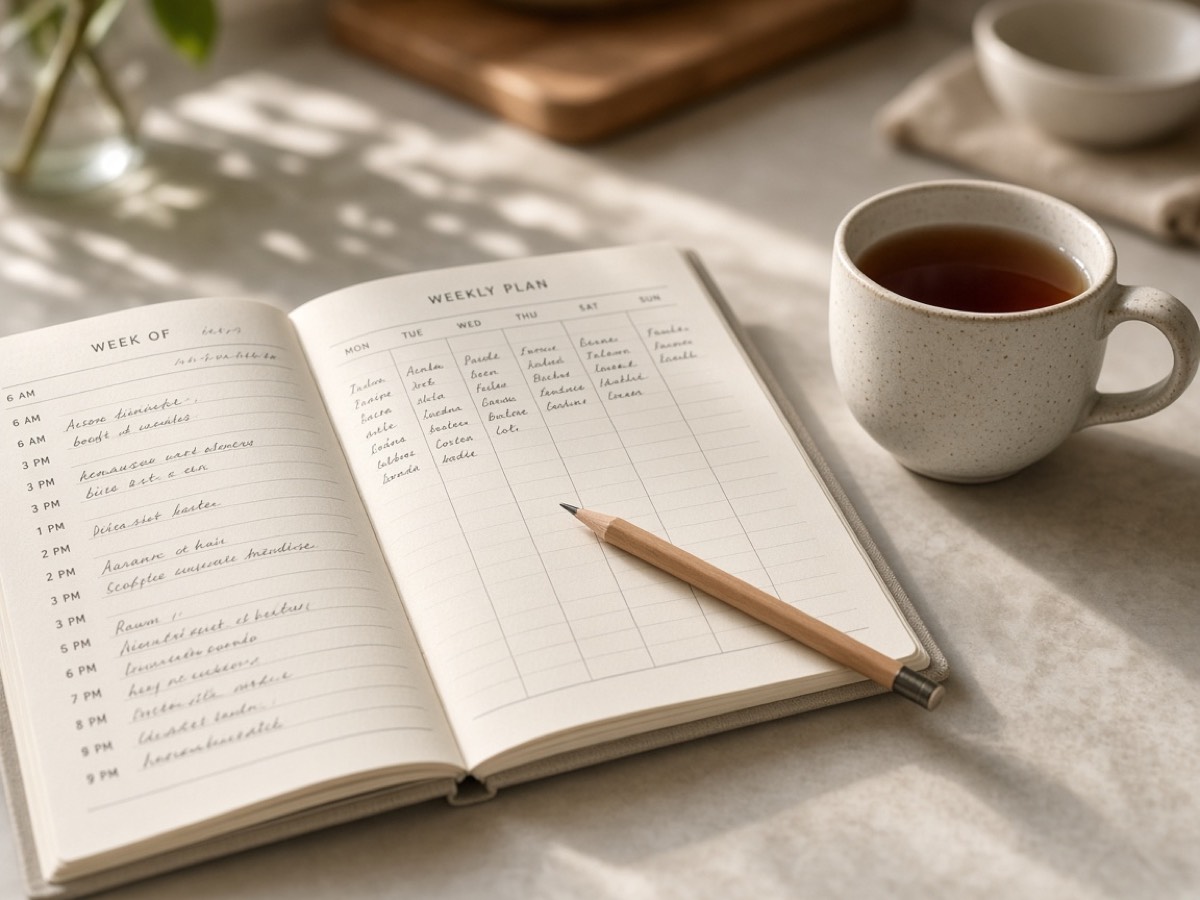
A realistic homeschool week is one to two hours a day for a five-year-old, three to four for a middle schooler and four to six for a high schooler, planned across four days rather than five. Families who try to reproduce a seven-hour school day at home almost always abandon the schedule within a month, and conclude they have failed at homeschooling rather than at scheduling.
Why home takes so much less time
A school day is long for reasons that mostly have nothing to do with teaching. Thirty children arriving, settling, moving between rooms, queueing, being counted, having instructions repeated for the third time, and being paced at a speed that is too slow for a third of the room and too fast for another third.
At home, almost all of that disappears. A one-to-one explanation that takes four minutes takes twenty in a classroom, because it has to be delivered to everyone, checked across everyone, and repeated for whoever missed it.
So the right comparison is not school hours. It is the amount of content covered, and that is why a child can finish a full curriculum in three hours and still have done a complete day's work.
Hours by age
| Age | Focused academic time | Shape of the day |
|---|---|---|
| 5 to 7 | 1 to 2 hours | Short blocks of 15 to 20 minutes, heavy on reading aloud and play |
| 8 to 10 | 2 to 3 hours | 30-minute blocks, a morning session and a short afternoon one |
| 11 to 13 | 3 to 4 hours | 45-minute blocks, increasing independent work |
| 14 to 18 | 4 to 6 hours | Subject-length sessions, mostly self-directed with check-ins |
These are hours of focused academic work. They exclude reading for pleasure, projects, music practice, sport and the large amount of incidental learning that happens in a household where somebody is paying attention.
A week that holds up
For a high schooler taking five subjects:
Monday to Thursday, four blocks a day:
- Hardest subject first. Usually maths or a science. This slot is non-negotiable and never moves.
- Second core subject. English or the other science.
- Break, properly, away from the desk.
- A lighter subject. History, language, electives.
- Independent work. Reading, practice, project time, with you available but not teaching.
Friday is deliberately not a content day:
- Catch up anything that slipped
- The week's lab, project or longer piece of writing
- Retrieval: explain the week back, no notes. Forty minutes, and the most valuable slot in the week
That Friday retrieval session is the one most families cut, and it is the one that determines how much is left in June. Being asked to recall material does more for long-term retention than studying it again for the same time, a finding from Roediger and Karpicke in 2006 that the 2013 Dunlosky review rated as one of only two high-utility study techniques, alongside spacing practice out.
The four-day rule
Plan four days of new content. Leave the fifth genuinely open.
Something will happen every single week: a cold, a dentist, a visitor, a day where somebody is simply not able to work. If your plan assumes five productive days, each of those becomes a debt, the debts accumulate, and by November you are three weeks behind and the schedule is dead.
With a four-day plan, a lost day costs nothing. Nothing is more motivating in March than being exactly where you meant to be.
Hardest thing first, always
Put the subject your child finds hardest in the first slot of the day, every day.
Two reasons. Attention and willingness decline through the day, so the hard thing gets the best version of your child. And the hard subject is the one that gets skipped when the day runs short, which means it gets skipped repeatedly, which is exactly how a small gap becomes the reason a family drops a subject in year two.
Three worked weeks
A seven-year-old, roughly 90 minutes a day. Reading aloud together (20 minutes), phonics or reading practice (15), maths (20), and one of writing, science or history (20). Short blocks with movement in between. The rest of the day is play, which at this age is not a gap in the schedule.
An eleven-year-old, roughly three hours. Maths first (45), then English (45), a break, then a rotating third subject (40), then independent reading or project work (30). One longer science or history session once a week in place of the rotation.
A sixteen-year-old taking five subjects, roughly five hours. Two 60-minute blocks before lunch on the hardest subjects, two 45-minute blocks after on the rest, and an hour of independent work. Four days of this, with Friday for the lab, the essay and the weekly retrieval session.
Teaching several children at once
The arithmetic defeats most new homeschooling families: three children needing one-to-one maths is three hours of your attention that cannot overlap.
What works:
- Combine what can be combined. History, science topics, read-alouds, art and music can be taught across a span of ages at once, with different output expected from each.
- Stagger the one-to-one subjects. Maths and reading instruction need you. Timetable them so only one child needs you at a time.
- Build independent work deliberately. A seven-year-old working alone for twenty minutes is a skill that has to be taught, starting at five. It is the highest-return investment in a multi-child household.
- Use the oldest as a teacher, sparingly. Explaining to a sibling genuinely helps the explainer. It is not a substitute for your teaching and resents being made into one.
Year shapes that are not the school year
Nothing requires September to June with a long summer.
- Six weeks on, one week off. The most popular alternative, and it prevents the mid-term collapse a twelve-week run produces.
- Four days a week, all year. Shorter days, no long summer, no September relearning.
- Term time plus a light summer. Maths and reading continue at half pace, which removes the biggest cause of autumn backtracking.
The last one is worth considering specifically because of the spacing effect: material revisited over the summer survives, and material parked for ten weeks largely does not.
What to do when it stops working
Three honest diagnoses, in the order worth checking:
The curriculum is too long, not your child too slow. Many published curricula are built so no family can accuse them of being thin. Cutting a programme's volume by a third is normal and usually costs nothing.
The schedule has no slack. See above.
The subject needs someone else. When one subject consistently produces tears or arguments, hand it to a tutor, a co-op or a tool. Preserving the relationship is worth more than any single credit.
Where TruLearn fits
A TruLearn session is about thirty minutes, which is roughly one concept taught, practised and explained back. It is designed to be one of the blocks above, run by the student without a parent sitting beside them: it arrives with its own plan, teaches out loud, and schedules the specific thing a student got wrong to come back days later, so the spacing happens without you maintaining a review calendar.
It teaches AP Biology and introductory college biology, and there is no parent dashboard yet. See how a session works, or how to tell whether something landed.
Frequently asked questions
- How many hours a day should we homeschool?
- Roughly one to two hours for ages five to seven, two to three for eight to ten, three to four for eleven to thirteen, and four to six for high school. If you are substantially above that and not finishing, the problem is usually the curriculum's volume rather than your child's pace.
- Why is this so much less than a school day?
- A school day spends large amounts of time on transitions, registration, waiting for thirty children to settle, repeating instructions, and pacing to the middle of a class. One-to-one at home removes nearly all of it. The teaching content of a school day is a fraction of its length.
- Should we homeschool five days a week?
- Plan four and keep the fifth loose. Something always happens - illness, an appointment, a day that falls apart - and a five-day plan with no spare capacity converts every disruption into a backlog. Four-day planning is the single most reliable way to still be on schedule in March.
- What time of day is best?
- Mornings for most children, and specifically the hardest subject first. Attention and willingness decline through the day, and the subject your child dreads is the one most likely to get skipped if it sits at the end.
- How do I handle multiple children at different levels?
- Teach the subjects that can be combined together across ages - history, science topics, read-alouds - and stagger the one-to-one subjects, maths especially. Younger children working independently while you teach an older one is a skill that has to be built deliberately, not assumed.
Keep reading

Homeschooling
How to homeschool a subject you never learned yourself
You do not need to know the subject to teach it well. You need a source that does, a way to check understanding, and the honesty to say when you are lost.
Oct 3, 20268 min read

Homeschooling
Homeschooling statistics: how many families, and who they are
How many American children are homeschooled, how fast that number grew after 2020, and why two credible sources give very different answers.
Oct 3, 20265 min read

Homeschooling
How to teach high school biology at home
A full-year plan for homeschooling biology: what to cover, how to handle labs without a school lab, and how to make it count for a transcript or an AP exam.
Oct 3, 20266 min read